
What to discuss at a well-woman exam
A well-woman exam is your annual opportunity to focus on preventive health specific to women — cervical cancer screening, breast health, contraception, menopause, bone health, and sexual health. At Paeon Health in Bolingbrook, IL, Walid Sayyed, MD, provides comprehensive well-woman care as part of family medicine, with the same unrushed, evidence-based approach he brings to all primary care.
Whether you are due for a Pap smear, considering contraception, navigating perimenopause, or simply want a primary care physician who understands women’s health, Paeon Health offers personalized care in a comfortable, respectful setting. Spanish assistance via translation is available.
Well-woman care is appropriate for all adult women — from young adults establishing care to postmenopausal women managing bone and heart health. For complex gynecologic conditions, we refer to OB/GYN specialists and coordinate care closely.
What Is a Well-Woman Exam?
A well-woman exam (also called an annual well-woman visit or gynecologic preventive visit) focuses on preventive care specific to women’s health. It typically includes:
- Health history update: menstrual history, pregnancies, contraception, sexual health, menopause status, family history (breast, ovarian, colon cancer), medications, lifestyle.
- Physical exam: vitals, weight, BMI, thyroid, heart, lungs, abdomen. A pelvic exam and breast exam may be performed based on age, symptoms, and guidelines — not every woman needs a pelvic exam every year.
- Cervical cancer screening: Pap smear and/or HPV testing per current guidelines (starting at age 21; intervals vary by age and results).
- Breast health: clinical breast exam and mammogram referral based on age and risk.
- Contraception counseling and prescriptions (oral contraceptives, etc.). Some forms (IUD, implant) require referral to OB/GYN.
- STI screening based on risk.
- Bone health assessment and DEXA referral when indicated (age 65+ or earlier with risk factors).
- Immunization review: HPV vaccine through age 26 (shared decision to 45), Tdap, flu, COVID, shingles at 50+, pneumonia at 65+.
- Mental health screening: depression, anxiety, intimate partner violence screening.
- Menopause counseling for perimenopausal and postmenopausal women.
When to call before your next well-woman exam
Schedule a visit (not wait for your annual) if you experience
- Abnormal vaginal bleeding — heavy periods, bleeding between periods, bleeding after sex, or any bleeding after menopause
- Severe menstrual cramps or PMS affecting daily life
- Pelvic pain or pain during intercourse
- Vaginal itching, burning, unusual discharge, or odor
- Breast lump, nipple discharge (especially bloody), skin dimpling, or breast pain
- Hot flashes, night sweats, or sleep disruption from perimenopause
- Low libido or sexual health concerns
- Mood changes, depression, or anxiety
- Urinary symptoms — burning, frequency, incontinence
- Trying to conceive or planning pregnancy
- New diagnosis of osteoporosis or concern about bone health
Seek emergency care for: severe abdominal/pelvic pain, heavy bleeding with dizziness/fainting, fever with pelvic pain, chest pain, severe allergic reaction, or suicidal thoughts. Call 911.
How we plan a well-woman exam around your health history
Dr. Sayyed’s approach to well-woman care is individualized and evidence-based:
Guideline-based screening. We follow ACOG, USPSTF, AAFP, and ACS guidelines for cervical, breast, and colon cancer screening — and individualize based on your family history and risk factors. We do not over-test; we ensure you get what is right for you.
Shared decision-making. Mammography starting age, prostate (for partners), HPV testing, hormone therapy in menopause — these decisions involve trade-offs. We explain the evidence and help you decide based on your values.
Contraception counseling. We discuss all options — oral contraceptives, IUD (referred), implant (referred), Depo-Provera, barrier methods, permanent options — and help you choose what fits your life and health. We prescribe oral contraceptives and manage side effects.
Perimenopause and menopause support. We discuss hormone therapy (benefits and risks based on your age and health), non-hormone options, vaginal health, bone density, and heart health. We do not dismiss symptoms as “just aging.”
Sexual and reproductive health. We provide a safe, non-judgmental space to discuss libido, pain with sex, STI concerns, and pregnancy planning.
Coordination with OB/GYN. For pregnancy care, IUD/implant insertion, abnormal Pap follow-up (colposcopy), or complex gynecologic conditions, we refer to trusted OB/GYN specialists and stay involved in your overall care.
What to expect at your well-woman exam
Before your visit
- Book a first adult office visit in Elation or call 630-822-2242.
- Note the first day of your last period.
- Bring your medication list and vaccine record.
- Note any family history updates (breast, ovarian, colon cancer).
- Write down questions — contraception, menopause, symptoms, screening.
- If you expect to be menstruating on the appointment date, ask the office how to plan any cervical screening.
During your visit
- Vitals and health history update.
- Discussion of your concerns and goals.
- Physical exam as indicated — breast exam, pelvic exam with Pap/HPV testing if due.
- Screening and vaccine review; orders for mammogram, DEXA, labs as indicated.
- Contraception or menopause counseling if relevant.
- Clear explanation of results plan and next steps.
After your visit
- Ask when to expect the cervical screening report and how to follow up if it has not arrived.
- Referrals for mammogram, DEXA, or OB/GYN sent electronically.
- Prescriptions sent to your pharmacy.
- Follow-up scheduled if results require.
We review every result and contact you if anything needs attention. Abnormal Pap results are explained clearly and next steps (repeat testing, colposcopy referral) discussed.
Three topics to bring to a well-woman exam
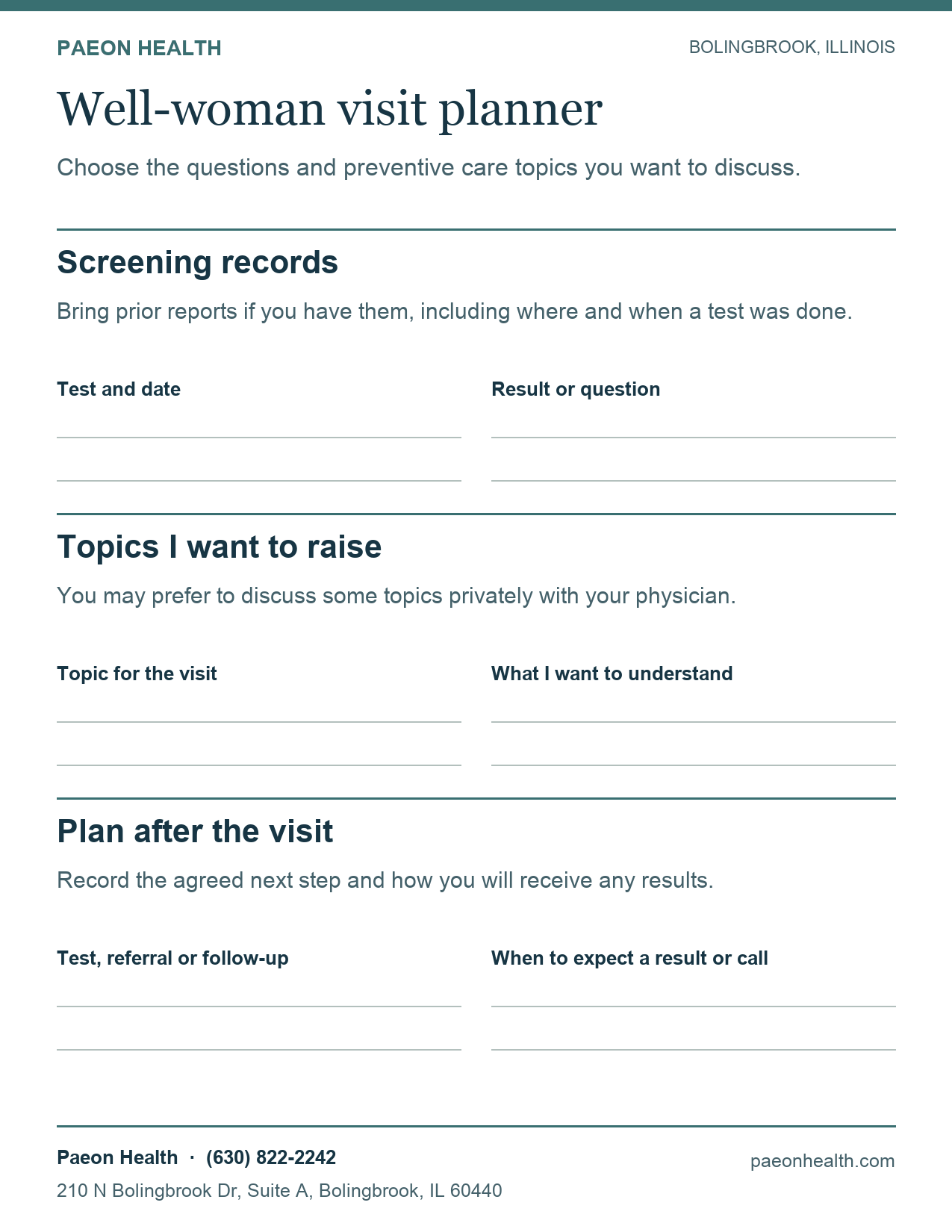
Use the visit to raise the issues that matter to you. If another provider completed a screening, bring the report or note the location and date so you can ask how it affects your next steps.
- Ask which screenings are due based on your personal history and previous results.
- Choose a topic you want time to discuss, such as cycles, contraception, menopause or sexual health.
- Before leaving, ask when and how you will receive results and who should arrange any follow-up.
Preview the well-woman visit planner
If another office sent you a screening reminder
Bring the reminder and the most recent report you can find. The name of the test and the recommendation after the last result can be more helpful than the date of a routine annual reminder. A prior biopsy or procedure may also matter. If you only have a portal message, note the name of the practice so you can ask which records would clarify the next step.
Records for bone health, medicines or follow-up
If bone health is a priority
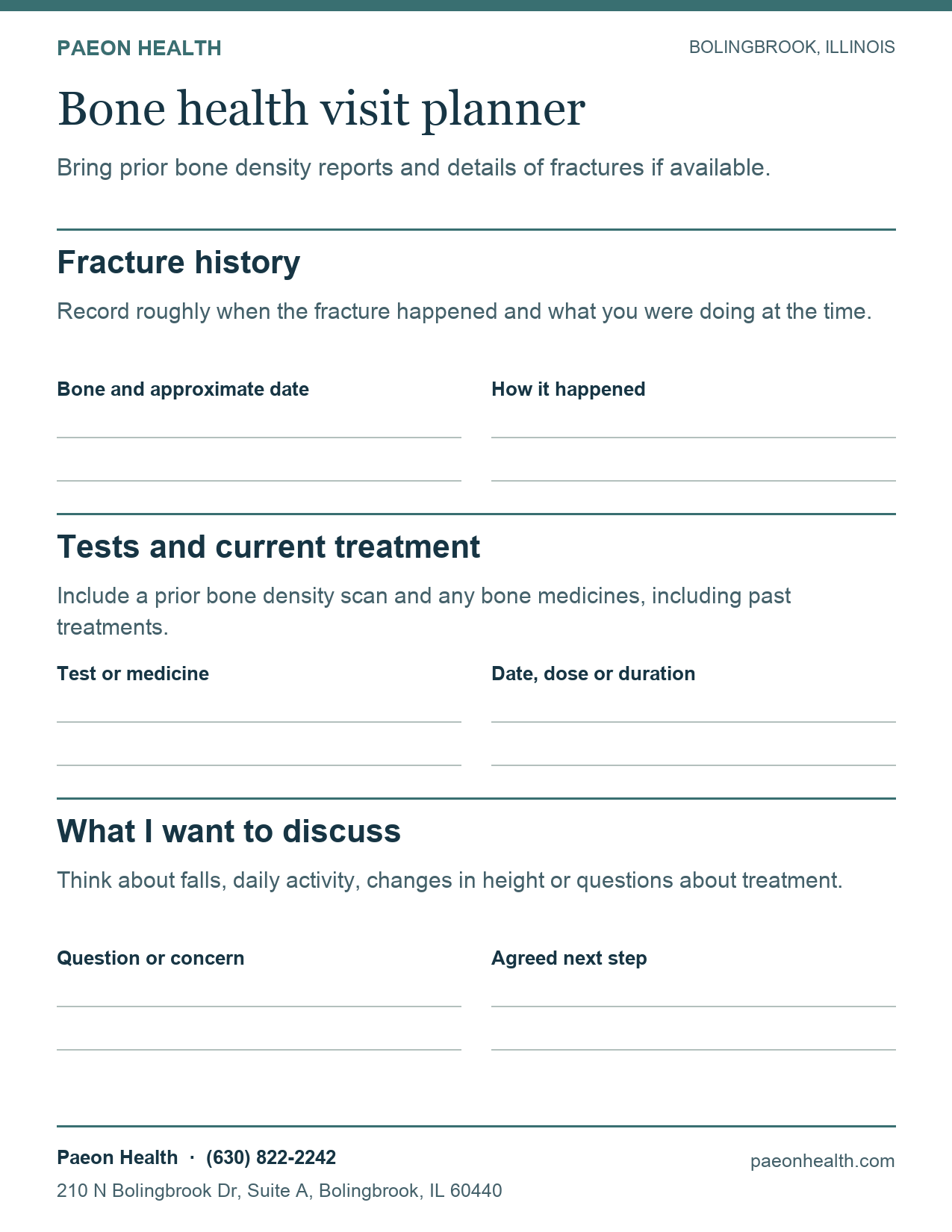
Bring a previous bone density report, a fracture history or details of prior treatment. The bone health planner keeps those notes together for a focused discussion.
Download the bone health visit planner (PNG)
If you want to review prescriptions or supplements
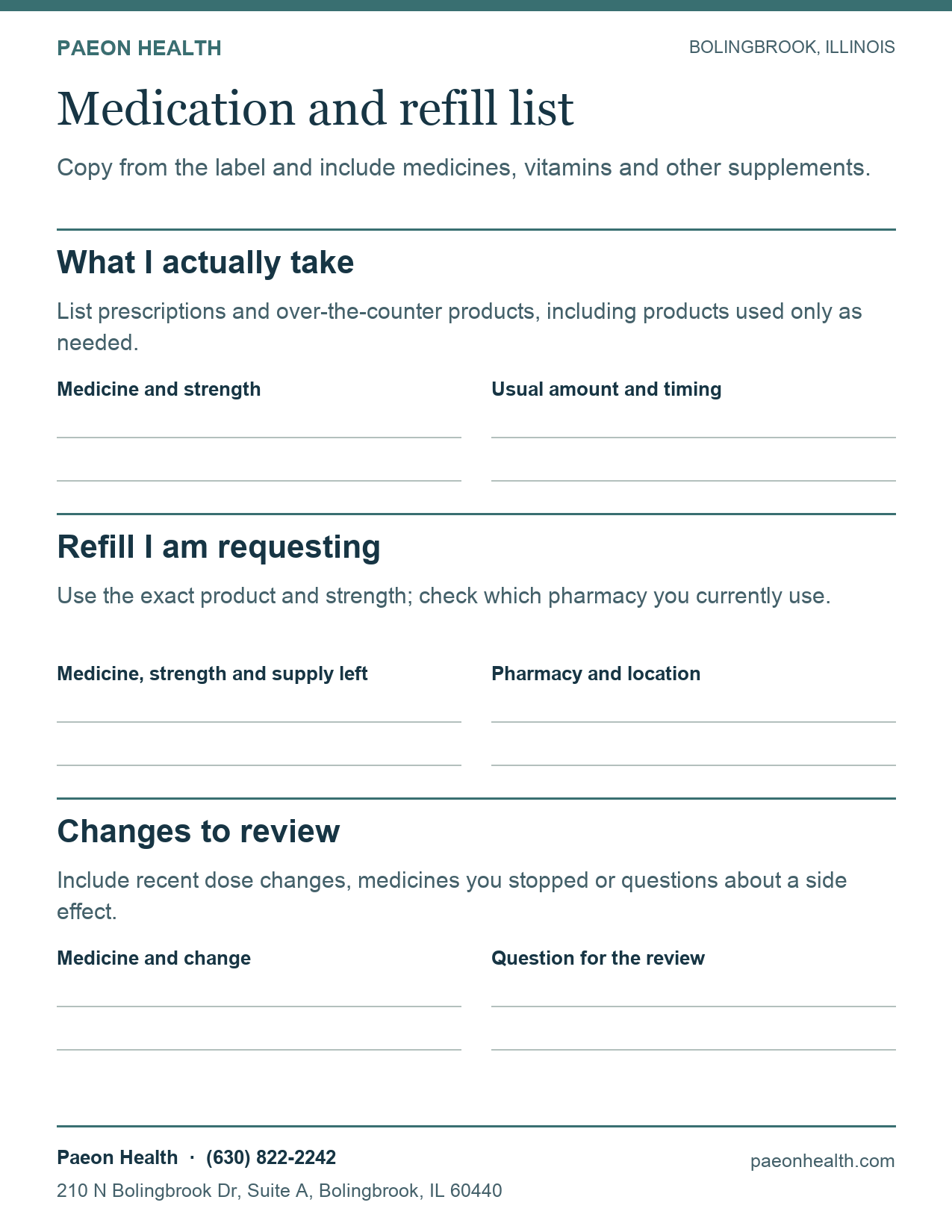
Write down the product and strength from each label. Include the name and start date of a treatment from another clinician if it relates to your question.
Download the medication and refill list (PNG)
If you need to arrange screening or follow-up
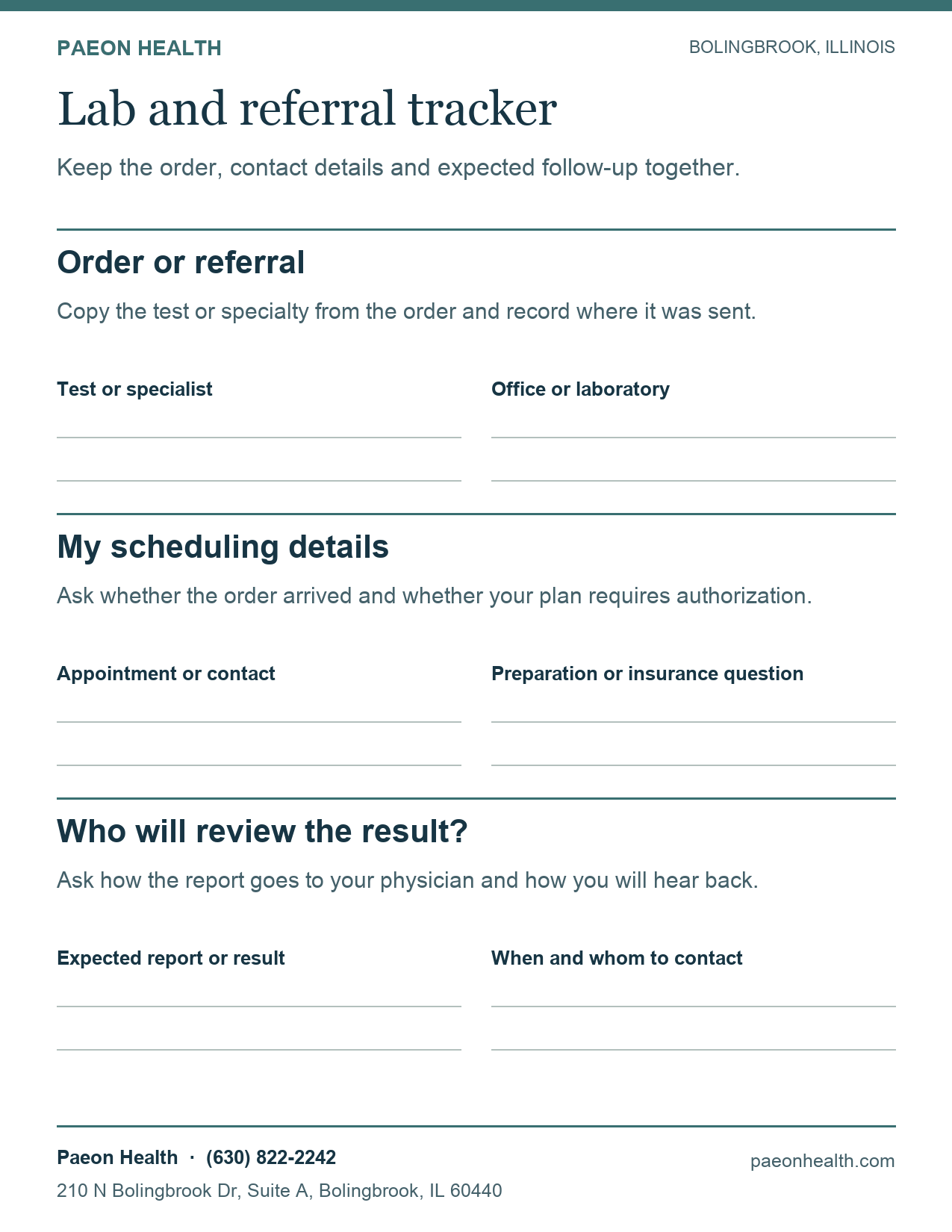
Use the test and referral tracker for the facility name, expected report and contact for follow-up. Keep reports from another office alongside it if available.
Download the lab and referral tracker (PNG)
Insurance & Self-Pay
Network participation depends on your exact plan and where you receive care. Verify your exact plan/network with your insurer. ACA plans cover well-woman preventive care and recommended screenings (Pap, mammogram, contraception counseling) at 100% cost-sharing. Problem-focused components may be billed separately.
Self-pay: New Patient Office visit $225; Annual Physical $225; Established Follow-Up $150. Pap smear, labs, mammogram, DEXA, and other tests/procedures are extra. A Good Faith Estimate is available.
FAQ
Q: Do I need a Pap smear every year? A: No — guidelines recommend Pap every 3 years (ages 21–65), or Pap+HPV co-testing every 5 years (ages 30–65). Your provider determines the right interval based on your history.
Q: At what age should I start mammograms? A: Shared decision-making starting at 40; routine screening generally recommended by 50. If you have a family history or genetic risk, earlier screening may be indicated. Discuss with Dr. Sayyed.
Q: I’m postmenopausal — do I still need well-woman visits? A: Yes — bone health, heart health, breast and colon cancer screening, vaginal health, and medication review remain important. Cervical cancer screening may stop at 65 with adequate negative prior screening.
Q: Can you prescribe birth control? A: Yes — oral contraceptives and other reversible methods can be prescribed. IUDs and implants require referral to OB/GYN for insertion.
Q: Do I need a pelvic exam every year? A: Not necessarily. Annual pelvic exams are no longer universally recommended for average-risk, asymptomatic women. We individualize based on your symptoms and history.
Q: Do you treat menopause symptoms? A: Yes — we discuss hormone therapy (when appropriate) and non-hormone options, vaginal health, bone density, and overall wellness during this transition.
Schedule a Well-Woman Exam
View appointment options · Explore primary care services
Patient resource: MedlinePlus guide to women’s health.
Schedule your well-woman exam with Walid Sayyed, MD, at Paeon Health in Bolingbrook, IL. Book via the Elation Patient Passport or call 630-822-2242. Email: care@paeonhealth.com. Office: 210 N Bolingbrook Dr, Suite A, Bolingbrook, IL 60440. Hours: Mon–Fri 9AM–5PM, Sat 9AM–1PM. Telehealth across Illinois available when clinically appropriate for follow-up and counseling.
This content is for educational purposes only and is not medical advice. For medical emergencies, call 911. To discuss your specific health needs, book an appointment with Walid Sayyed, MD, at Paeon Health or call 630-822-2242.