
Smoking cessation support at Paeon Health starts with your experience. Tell Dr. Sayyed what makes quitting difficult, what helped in a past attempt and whether you want to discuss counseling, medicine or both.
At Paeon Health in Bolingbrook, IL, Walid Sayyed, MD — board-certified family medicine physician — offers personalized smoking cessation support as part of primary care, including counseling, medication options, and follow-up. Dr. Sayyed also helps patients transition away from vaping and e-cigarettes.
What Is Smoking Cessation?
Smoking cessation is the process of quitting tobacco use — cigarettes, cigars, pipes, smokeless tobacco, and increasingly, vaping/e-cigarettes. It addresses both the physical dependence on nicotine and the behavioral habits and triggers that keep people smoking. Successful cessation usually combines support (counseling) with medication, which roughly doubles quit success rates compared to trying alone.
Signs That It’s Time to Quit
You may be ready to quit if you:
- Have noticed a cough, shortness of breath, or reduced fitness
- Want to improve your health and reduce cancer and heart disease risk
- Are planning pregnancy or want to protect family from secondhand smoke
- Are concerned about the cost of smoking
- Have tried to quit before and want support this time
- Use vaping or e-cigarettes and want to stop all nicotine
Seek care sooner if you have a persistent cough, coughing up blood, chest pain, unexplained weight loss, or worsening shortness of breath — these need prompt evaluation.
Smoking cessation support at Paeon Health
Dr. Sayyed uses a supportive, non-judgmental approach:
- Readiness assessment — where you are: thinking about quitting, preparing, or ready to set a quit date. The plan matches your readiness.
- Health review — how smoking is affecting you (cough, lung function, blood pressure, circulation) and any conditions you have (asthma, COPD, heart disease, diabetes).
- Past quit attempts — what helped, what was hard, and what to do differently.
- Triggers and routines — identifying when you smoke most (morning coffee, driving, after meals, stress) and planning alternatives.
- Medication options — several FDA-approved aids (nicotine replacement therapy and prescription medications) can reduce cravings and withdrawal. They are discussed, not automatically prescribed; specific choices and doses are decided in person, considering your health and preferences.
- Counseling and resources — referral to counseling, support groups, or the Illinois Tobacco Quitline. Combining medication with counseling is most effective.
- Follow-up — check-ins around your quit date and beyond to support success and handle slips. Slips are common and do not mean failure.
Vaping and e-cigarettes are not approved as quit aids and carry their own risks. If you use them, tell Dr. Sayyed — he can help you transition away from all nicotine products.
What to expect at a smoking cessation appointment
- First visit — discussion of your smoking history, readiness, health, and a personalized quit plan. If medication is appropriate, it is prescribed with clear instructions.
- Quit date — set a date within the next few weeks. Prepare by removing tobacco from home, car, and work; telling friends and family; and identifying triggers.
- Follow-up — often a check-in shortly after the quit date, then periodic visits to support long-term success and manage weight or mood concerns.
- Relapse prevention — identifying high-risk situations and planning how to handle them.
Telehealth follow-up across Illinois is available when clinically appropriate, with the patient physically in Illinois.
What to Expect After Quitting: A Timeline
The body begins healing quickly after the last cigarette. Understanding the timeline can help you through the hardest days:
- 20 minutes after quitting — heart rate and blood pressure begin to drop toward normal.
- 12–24 hours — carbon monoxide levels in blood fall to normal; oxygen levels improve.
- 2–3 days — nicotine is largely out of the body; withdrawal symptoms (irritability, cravings, trouble concentrating, increased appetite, restlessness) peak and then begin to fade. Sense of taste and smell begins to improve.
- 1–2 weeks — circulation and lung function start improving; coughing and shortness of breath may decrease.
- 1 month — many people notice improved energy, better sleep, and reduced cough.
- 1 year — risk of heart disease drops by about half compared to when smoking.
- 5–10 years — risk of stroke and several cancers continues to decline.
- 10+ years — risk of lung cancer drops to about half that of a continuing smoker; risk of other cancers continues to fall.
Withdrawal and cravings are strongest in the first week and fade over weeks. Identifying trigger situations (stress, after meals, driving, alcohol, social smoking) and planning alternatives — a walk, deep breathing, a glass of water, sugar-free gum — helps. Slips are common; most people who quit for good had one or more slips along the way. A slip is not failure — it is information about what triggered you, and the plan can be adjusted. Weight gain of a few pounds is common; planning activity and nutrition with Dr. Sayyed can minimize it, and the health benefits of quitting far outweigh a small weight gain.
Three steps to prepare for smoking cessation support
You can discuss smoking cessation whether you are ready to set a quit date or are still considering it. Start with one situation you know well and work out what kind of support you want.
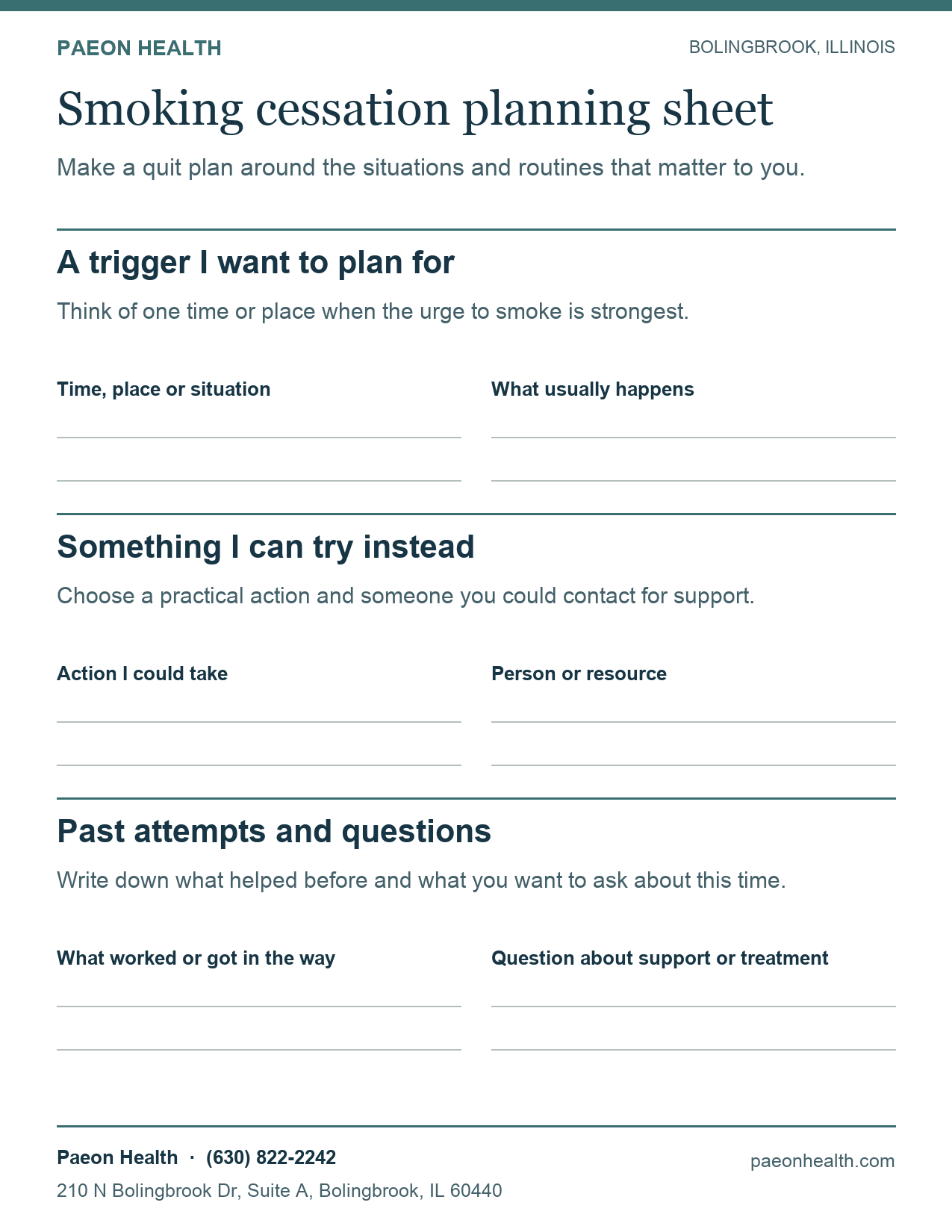
- Name a time, place or routine when the urge to smoke is strongest.
- Write down one alternative you would consider and someone you could turn to for support.
- Recall what helped in a previous attempt and what got in the way. Bring questions about counseling or medication to your visit.
Preview the smoking cessation planning sheet
What to bring back after a difficult day
A craving that caught you off guard is useful information for your next smoking cessation discussion. Record what was happening just beforehand, who was with you and whether your usual source of support was available. One specific example often gives you more to work with than trying to describe an entire week.
If you used a quit aid, bring its name and how you used it. If you stopped it, note whether the issue was cost, an unwanted effect, a complicated schedule or something else. Ask which alternatives might fit that particular barrier.
At follow-up, choose the situation you want to plan for next. It might be the drive to work or a social event where others smoke. Write down the change you want to try and when you would like to review how it went.
Prepare for a conversation about treatment and breathing
If you want to discuss medicine to help you quit
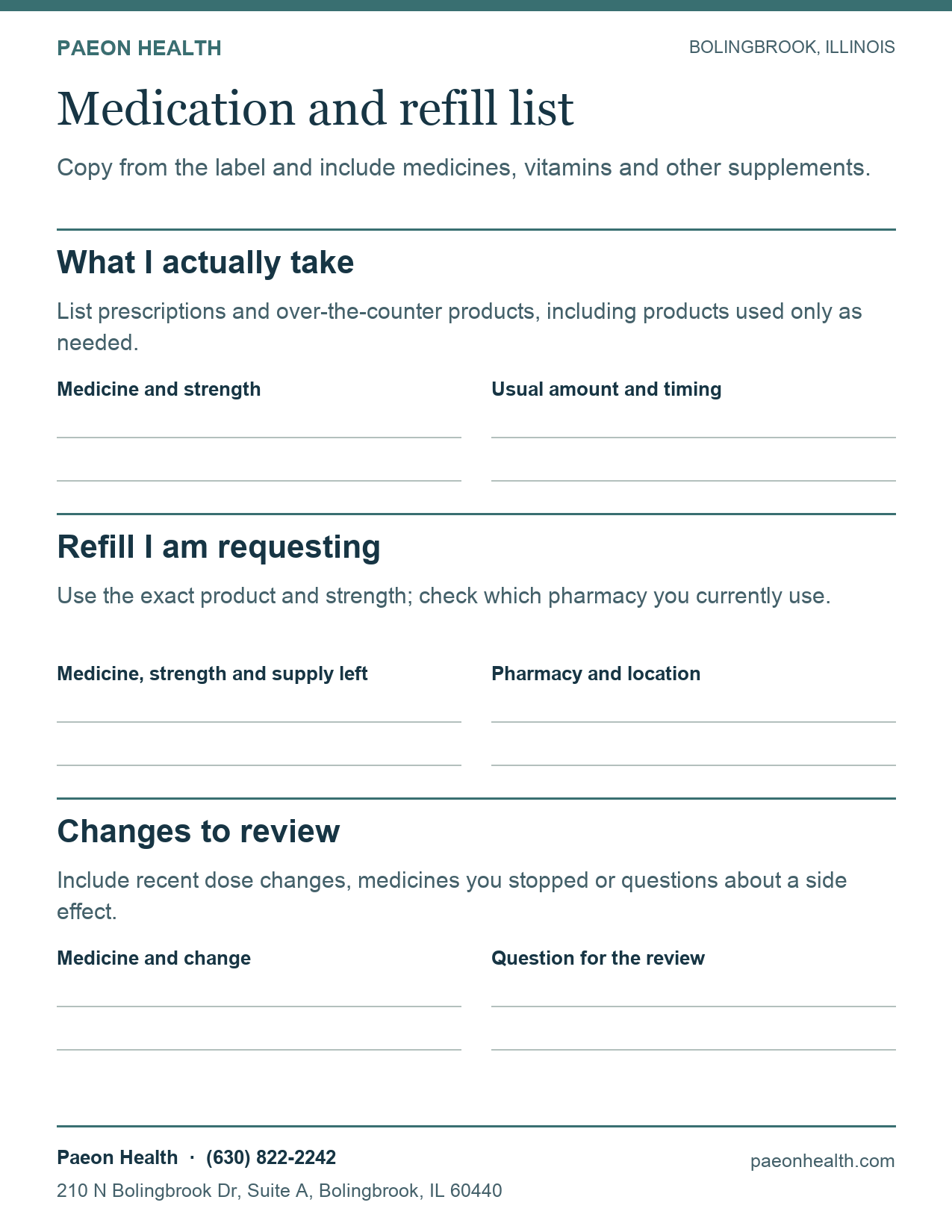
List medicines and supplements you already take, along with quit aids you have tried in the past. Write down the product name and what happened when you used it.
Download the medication and refill list (PNG)
If you already have COPD
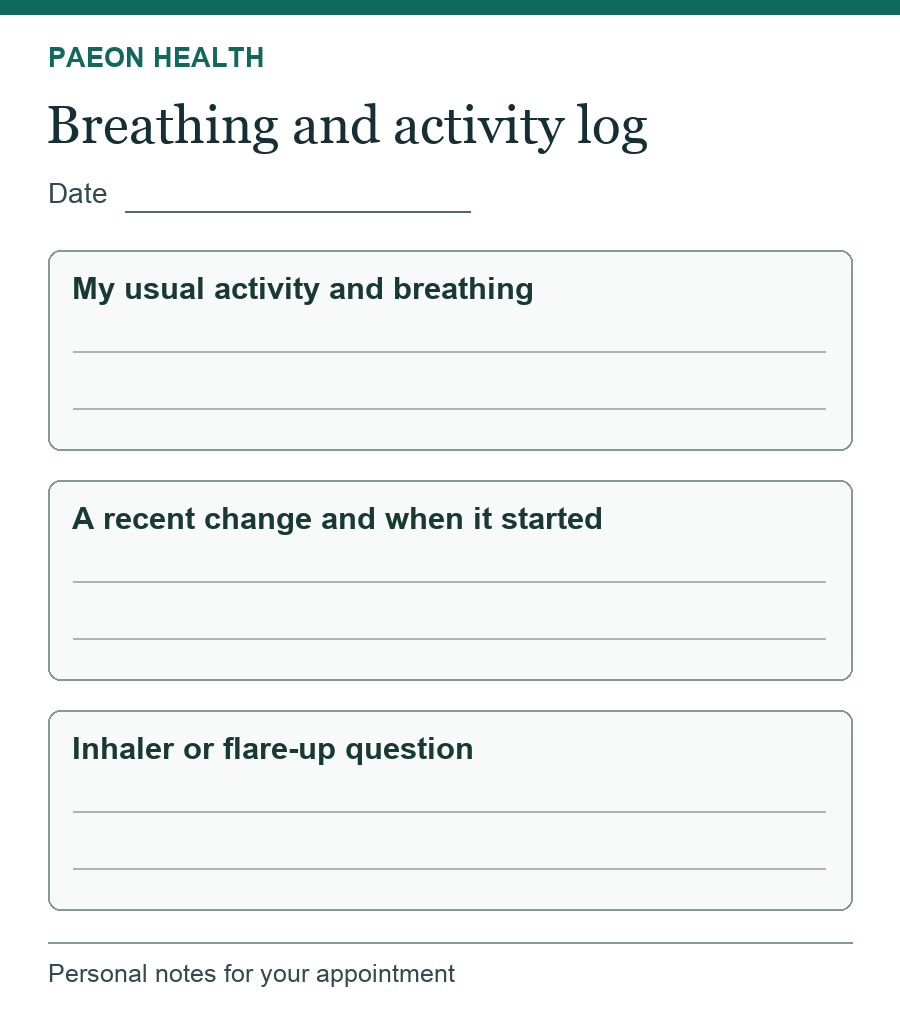
The breathing and activity log helps you describe changes in a familiar daily activity. Bring these observations separately from your notes about smoking triggers.
Download the copd breathing activity log (PNG)
If a follow-up for quitting smoking is scheduled by video
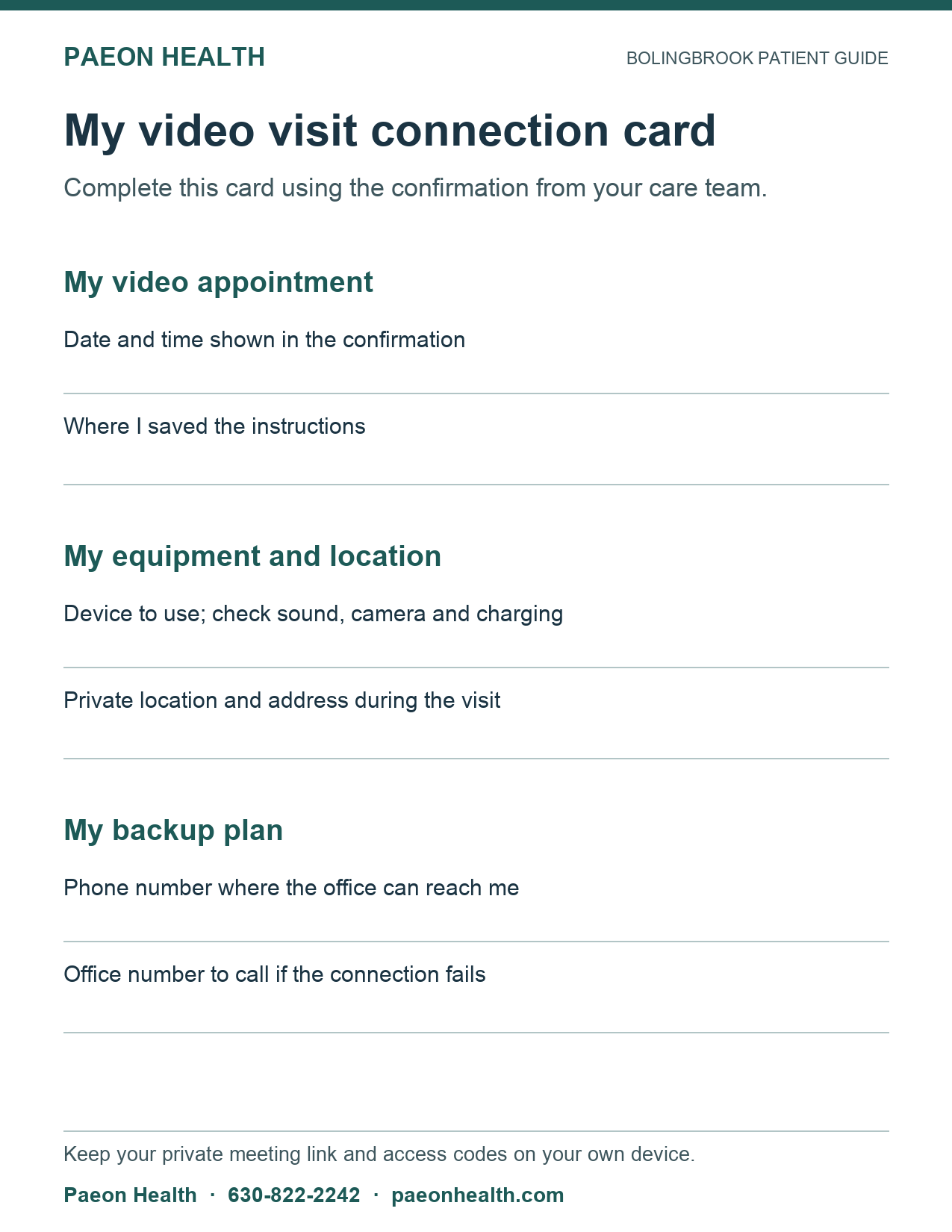
Use the connection card to keep your visit time, link location and backup contact together. At the follow-up you can show your quit-planning notes and discuss what has changed since the last conversation.
Download the my video visit connection card (PNG)
Insurance & Self-Pay
Network participation depends on your exact plan and where you receive care. Verify your exact plan and network with your insurer. Many plans cover cessation counseling and some medications. For self-pay patients, a New Patient Office visit is $225 and an Established Follow-Up is $150. Medications are extra. A Good Faith Estimate is available.
FAQ
How many times do people try before quitting for good? Many people make several attempts. Each attempt teaches you something — it is not a measure of willpower.
Will I gain weight? Some people gain a small amount. Planning activity and nutrition with your doctor can minimize this, and the health benefits of quitting far outweigh a few pounds.
Are e-cigarettes safer than cigarettes? They are generally considered less harmful than combustible cigarettes for adults who switch completely, but they are not harmless and not approved as quit aids. Many people end up using both. The goal is to stop all nicotine.
Can I quit “cold turkey”? Some people do, but success rates are higher with medication and/or counseling. Your doctor can help you choose the approach that fits you.
Is it too late to quit if I have smoked for decades? No. Benefits begin at any age, even after smoking-related disease has developed.
What if I am not ready to quit? That’s okay. A visit can explore your reasons for smoking and for quitting, and help you move toward readiness when you are.
Schedule a smoking cessation visit in Bolingbrook
View appointment options · Explore primary care services
Patient resource: MedlinePlus guide to quitting smoking.
If you are ready to quit — or even thinking about it — a primary care visit can give you a plan, medication if appropriate, and ongoing support. Book an appointment with Walid Sayyed, MD, at Paeon Health in Bolingbrook, IL, via the Elation Patient Passport portal, or call 630-822-2242.
This content is for educational purposes only and is not medical advice. For medical emergencies, call 911. To discuss your specific health needs, book an appointment with Walid Sayyed, MD, at Paeon Health or call 630-822-2242.