
Thyroid care begins with a review of your symptoms and health history.
Fatigue, weight changes, hair loss and feeling unusually hot or cold have several possible explanations. At Paeon Health in Bolingbrook, Walid Sayyed, MD, a board-certified family physician, reviews your symptoms, medicines and previous results to decide whether you would benefit from testing or a different evaluation.
An appointment can address a new concern or an established diagnosis. If a clinician started treatment elsewhere, bring a copy of the original result and your latest prescription label. If you are unsure why someone ordered a test, bring the report and ask what question it was intended to answer.
What Are Thyroid Disorders?
The thyroid is a small gland in the front of the neck that produces hormones called T3 and T4. The pituitary gland helps regulate their production by releasing a signal called TSH. A blood test can measure that signal and, when indicated, the amount of hormone circulating in your blood.
An underactive gland (hypothyroidism) produces too little hormone. A common cause in the United States is Hashimoto’s disease, in which the immune system attacks the gland. Previous surgery, radiation treatment and certain medicines can also affect hormone production. The history of these events can be as useful to your clinician as an individual result.
An overactive gland (hyperthyroidism) produces excess hormone. Graves’ disease is one possible cause. Nodules or inflammation can also change hormone levels. The underlying cause matters because treatments differ.
A nodule is a lump in the gland. Most are benign, and many occur in people whose hormone levels are normal. Depending on the examination and ultrasound appearance, monitoring or a needle biopsy may be appropriate. Bring the full imaging report, including the description and measurements, if a nodule has already been identified.
Blood tests and imaging answer different questions. TSH and free T4 help assess how the gland is working. An ultrasound can describe its size and structure. Ask which question a proposed test will answer and whether there is an earlier result that your physician should compare with it. Read the American Thyroid Association guide to function tests for an explanation of common test names.
Signs & Symptoms
With an underactive gland, possible symptoms include fatigue, feeling cold, constipation, dry skin, changes in weight or heavy or irregular periods. Many of these also occur for other reasons. Note which change came first and anything else that happened around that time.
With an overactive gland, possible symptoms include heat intolerance, sweating, a tremor, unintended weight loss, palpitations, trouble sleeping or frequent bowel movements. If several changes start together, a brief timeline can help communicate the pattern without having to remember the dates during the visit.
New or severe chest pain, severe trouble breathing, fainting or marked confusion can signal an emergency. Call 911 for emergency symptoms. Contact a clinician promptly about a new or enlarging neck lump, a persistent change in your voice or a racing heartbeat.
Thyroid Care at Paeon Health
What happens at an appointment depends on whether you have a new symptom, an abnormal result, a neck lump or a question about an existing prescription. Tell the office which of these brought you in.
History. Discuss the main change, its timing, any family history and other health problems. Mention recent pregnancy, a previous procedure or prior treatment if relevant. Bring a list of medicines and supplements, including products for hair, skin or nails. Some products can affect test results or how a medicine is absorbed.
Evaluation. An examination and review of prior results help determine what testing is appropriate. TSH is commonly used to start an evaluation. The need for free T4, antibody testing or another test depends on the clinical question. A change in a blood test does not automatically mean you need an ultrasound.
Results. Ask what your findings suggest and whether you need treatment now, a repeat measurement or referral to a specialist. An underactive gland is usually treated with hormone replacement. Options for an overactive gland depend on its cause, your health history and individual preferences. Your clinician can explain why a particular option fits your situation.
Follow-up. If you start or change treatment, agree on when to repeat a test, who is ordering it and how the result will reach you. Ask who will adjust your prescription if you see both a primary care physician and an endocrinologist. If you are pregnant or planning a pregnancy, tell your clinician promptly because monitoring and treatment needs can change.
What to Expect at Your Visit
Before a first visit. Bring the original laboratory report if you have it, a medication and supplement list and a timeline of symptoms. A dated result with its laboratory reference range is more useful than remembering it was described as high or low. If a previous consultation led to a procedure, note the clinician or facility that holds those records.
At a follow-up. Make a note of the last change in your dose or usual routine. Bring new results and identify a symptom that has improved, stayed the same or become more bothersome. Ask when to check back. Some follow-up can take place by telehealth when appropriate and when you are physically in Illinois.
If another office did the testing. Bring the full report or identify the laboratory and collection date. When your results come from different laboratories, keep their reference ranges with the values. For a prior ultrasound or biopsy, include the imaging facility, procedure date and any follow-up recommendation.
If you take levothyroxine. Ask your clinician or pharmacist about the timing of meals, calcium, iron and other products in relation to your prescription. Follow the directions for your own medicine. If those directions differ between a bottle and a visit summary, check with the prescribing clinician before making a change.
Three details to bring to a thyroid visit
If you already take thyroid medicine, write down your usual routine as well as the dose on the label. If you are coming for an initial evaluation, start with your symptoms and any earlier results.
- Dated thyroid test reports, including values and the laboratory’s reference ranges if available.
- Prescriptions and supplement labels, with the timing of each product and any recent changes.
- A short timeline of symptoms and the question you would like answered about treatment or follow-up.
Preview the thyroid visit planner
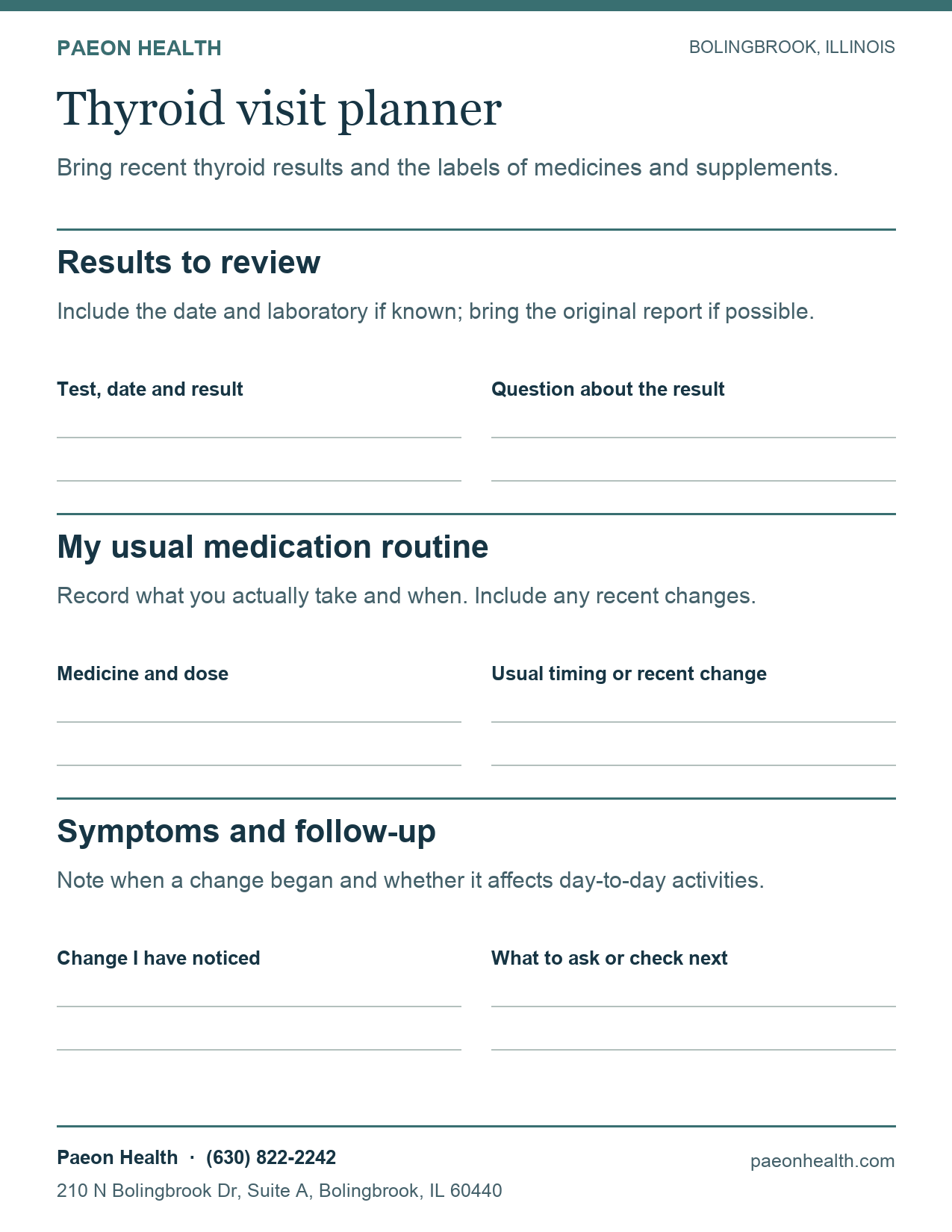
If you already take medicine or have outside thyroid results
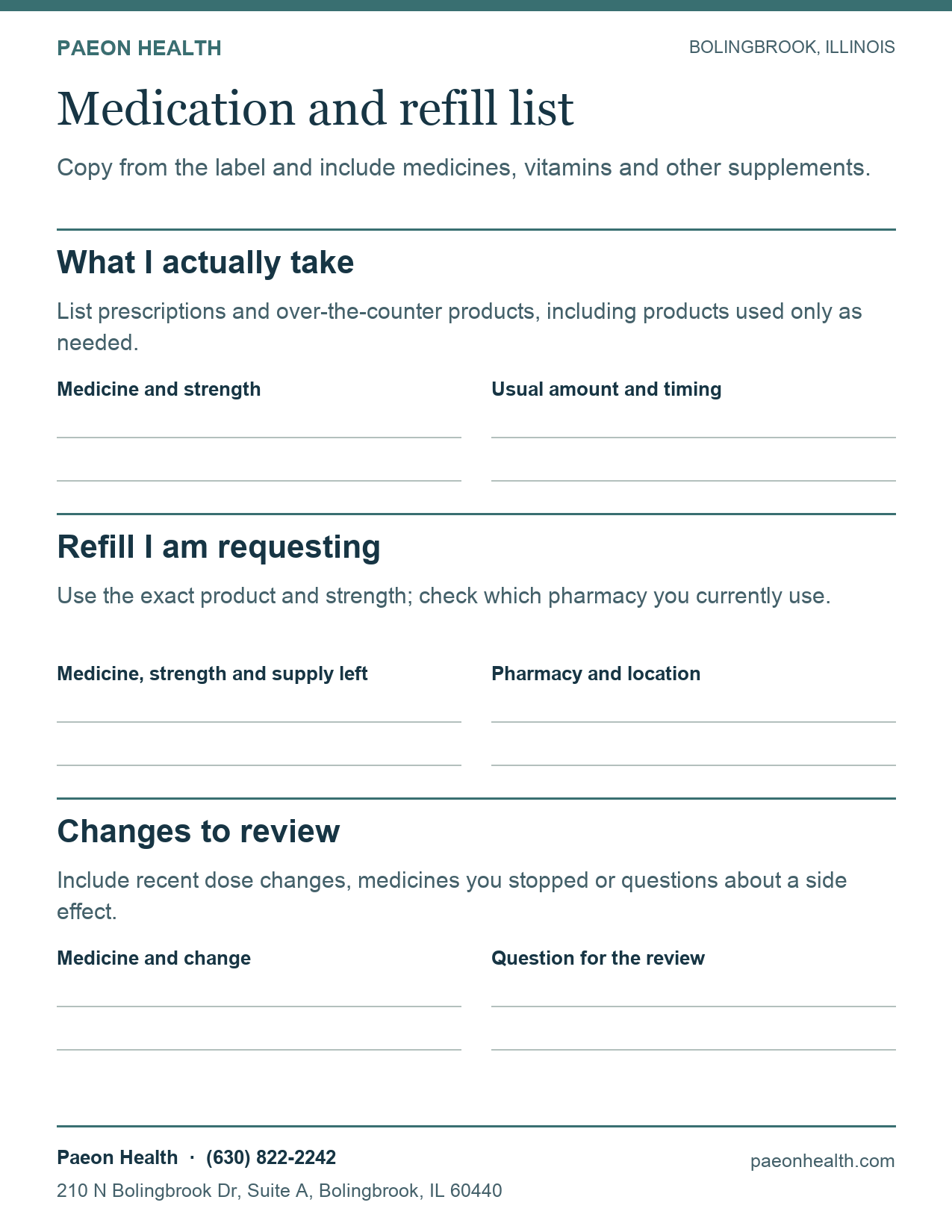
When several medicines or supplements are involved
Use the medication list to record the product, strength and usual timing from your own routine. A note about what you actually take can clarify discrepancies between older lists.
Download the medication and refill list (PNG)
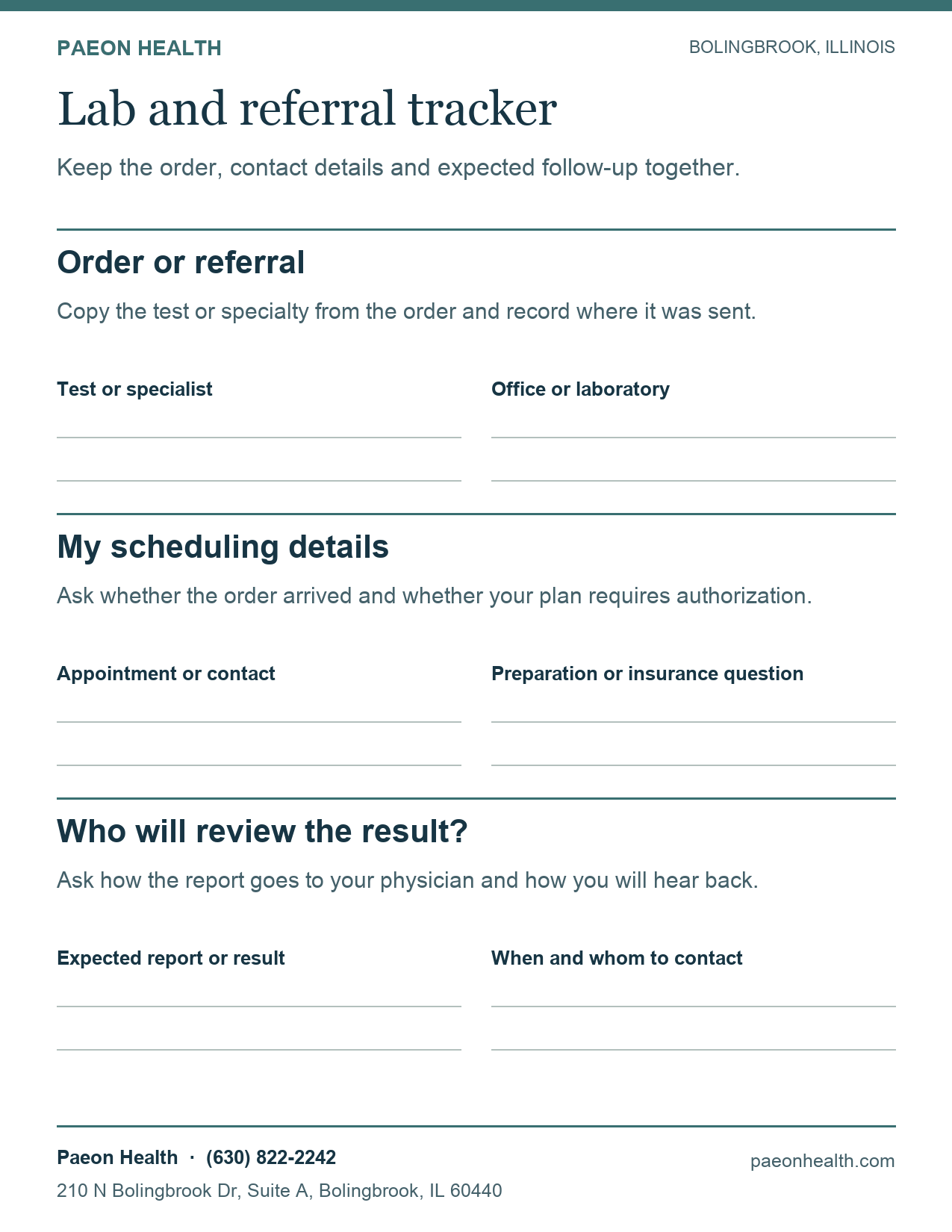
When your test was ordered or performed elsewhere
The lab and referral tracker helps identify the ordering clinician, testing location and where to request the report. Include a date instead of relying on memory of a prior result.
Download the lab and referral tracker (PNG)
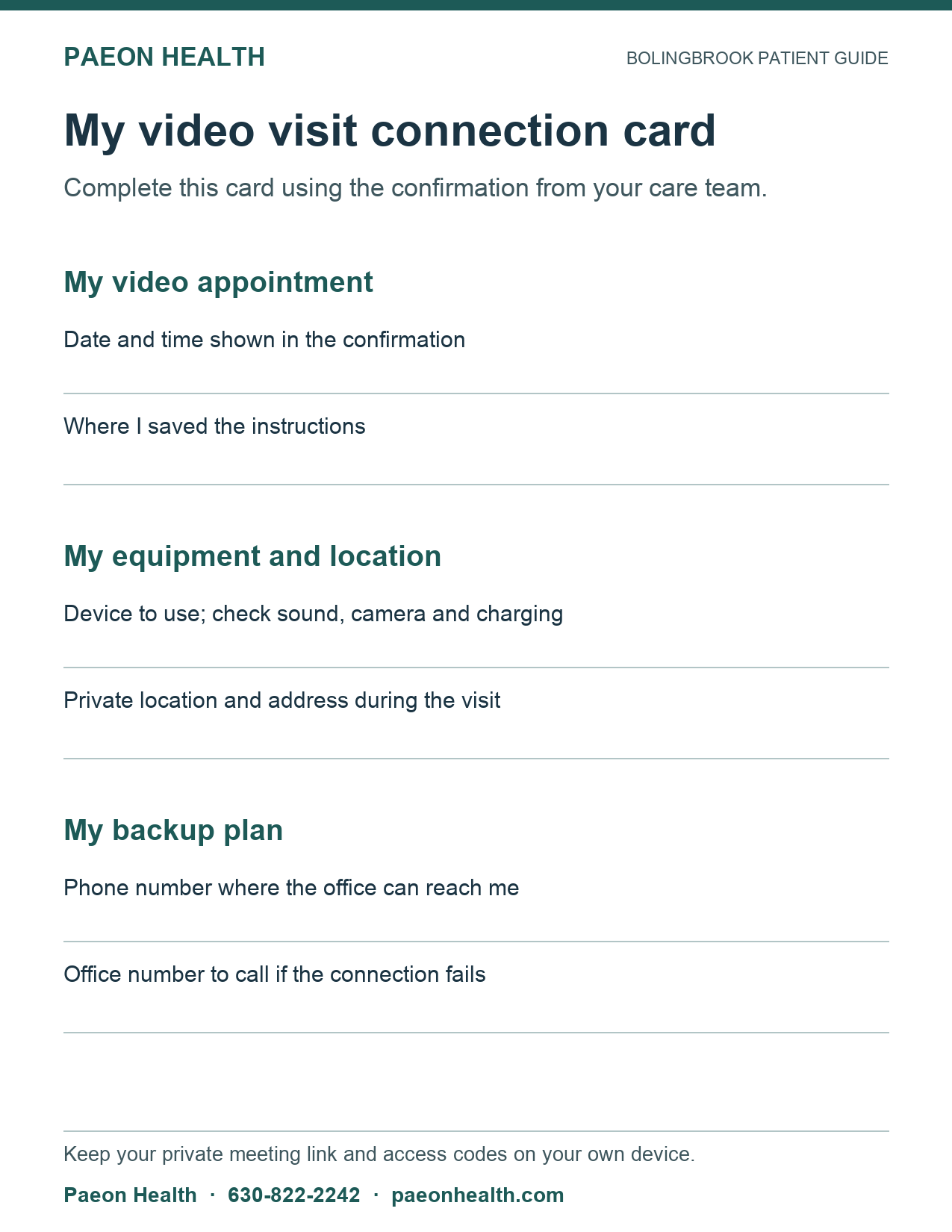
If your established follow-up will be by video
The connection card gives you space for the appointment time, where you will find the visit link and a backup call number. Have your medication list and results within reach when you join.
Download the my video visit connection card (PNG)
Insurance & Self-Pay
Network participation depends on your exact plan and where you receive care. Verify your exact plan and network. Self-pay prices: New Patient Office $225, Established Follow-Up $150, Established Patient Video $125, Annual Physical $225. Labs, thyroid ultrasound, biopsy, and medications are extra. A Good Faith Estimate is available on request. Ask your pharmacy for a price for your exact prescription.
FAQ
Q: My TSH is “normal” but I still feel tired. Could it still be my thyroid? A: Sometimes. We look at the full picture — free T4, symptoms, other causes. We also evaluate for anemia, sleep apnea, vitamin D deficiency, depression, and other mimics.
Q: Do I need to see an endocrinologist? A: Most hypothyroidism is managed well in primary care. Referral to endocrinology is considered for hyperthyroidism, nodules/cancer, pregnancy, or difficult-to-control cases.
Q: How long until I feel better on thyroid medication? A: Many people notice improvement within a few weeks, but full effect and dose adjustment can take 2–3 months. Be patient and keep follow-up appointments.
Q: Is natural/desiccated thyroid better? A: Standard treatment is levothyroxine (synthetic T4), which is well-studied and reliable. Ask about the evidence, risks and monitoring for any alternative you are considering. Bring the prescription label if a different clinician started your treatment.
Q: I have a thyroid nodule. Is it cancer? A: Most nodules are benign. We use ultrasound features and, if indicated, biopsy to determine next steps. Most people with nodules just need monitoring.
Q: Can thyroid problems cause weight gain? A: Hypothyroidism can contribute to modest weight gain, but it is rarely the sole cause of significant weight gain. We look at the whole picture.
Book Your Thyroid Evaluation
For a new concern or follow-up on a result, schedule an appointment with Walid Sayyed, MD, at Paeon Health in Bolingbrook. New adult office visits: Elation. Call about availability for a first video visit. Established patients: Elation Patient Passport portal. Questions? Call 630-822-2242. Office: 210 N Bolingbrook Dr, Suite A, Bolingbrook, IL 60440. Hours: Mon–Fri 9AM–5PM, Sat 9AM–1PM. Spanish translation assistance available.
View appointment options · Explore primary care services
Patient resource: MedlinePlus guide to thyroid disorders.
This content is for educational purposes only and is not medical advice. For medical emergencies, call 911. To discuss your specific health needs, book an appointment with Walid Sayyed, MD, at Paeon Health or call 630-822-2242.