
For a travel medicine visit in Bolingbrook, bring your itinerary and the date you leave. Dr. Sayyed can discuss health risks, vaccines or medicines relevant to your trip and help you identify services to arrange elsewhere.
At Paeon Health in Bolingbrook, IL, Walid Sayyed, MD — board-certified family medicine physician — offers Travel Medicine & Vaccinations as one of the practice’s core services. Dr. Sayyed reviews your itinerary, recommends and administers appropriate vaccines, prescribes malaria prevention and travel medications when needed, and provides personalized health advice for your trip.
What Is Travel Medicine?
Travel medicine is preventive care tailored to your specific trip. It considers:
- Your destination(s) — country, region, urban vs. rural, altitude
- Duration of travel and season
- Activities — hiking, swimming, safari, mission/medical work, visiting friends and relatives
- Your age, health conditions, pregnancy status, and medications
- Your vaccination history
- Current disease outbreaks and CDC/WHO guidance
The goal is to keep you healthy during travel and reduce risk of bringing illness home. Book your travel visit 4–6 weeks before departure — some vaccines require multiple doses or take time to provide protection. Last-minute visits can still be helpful.
Vaccines and medicines used in travel medicine
Depending on your itinerary, you may need:
- Routine vaccines updated — measles/mumps/rubella (MMR), tetanus/diphtheria/pertussis (Tdap), influenza, COVID-19, polio, varicella
- Hepatitis A — recommended for most travelers to developing countries (food/waterborne)
- Typhoid — for travel to South Asia, Africa, Latin America (food/waterborne)
- Hepatitis B — for travelers who may have medical exposure, tattoos, intimate contact, or extended stays
- Yellow fever — required for entry to some countries in sub-Saharan Africa and tropical South America
- Rabies — for travelers to remote areas, long-term travelers, cavers, veterinarians, and those working with animals
- Japanese encephalitis — for extended travel to rural areas of Asia and Western Pacific
- Meningococcal — for travel to sub-Saharan Africa “meningitis belt” or Saudi Arabia (Hajj/Umrah)
- Cholera — for travelers to areas with active cholera outbreaks
- Malaria prophylaxis — prescription medication taken before, during, and after travel to malaria-risk areas (specific drug depends on destination and resistance patterns)
- Traveler’s diarrhea kit — medication to treat diarrhea if it occurs, plus guidance on safe food and water
- Altitude sickness prevention — for travel to high altitude
- Motion sickness medication — if needed
Specific vaccines and medications are decided in person with Dr. Sayyed based on your itinerary and health.
Signs & Symptoms to Watch For After Travel
Seek medical care promptly if, after travel, you develop:
- Fever — especially within weeks of returning from a malaria-risk area (malaria can be fatal; tell providers your travel history)
- Persistent diarrhea, vomiting, or dehydration
- Jaundice (yellow skin/eyes) — possible hepatitis
- Rash with fever
- Persistent cough or difficulty breathing
- Animal bite or scratch during travel — rabies is fatal but preventable with prompt post-exposure treatment
Always tell any healthcare provider about your recent travel history.
How we plan a travel medicine visit
Dr. Sayyed’s travel visit includes:
- Itinerary review — countries, regions, length of stay, activities, type of accommodation.
- Vaccination review — checking your record and updating routine vaccines plus travel-specific ones.
- Prescriptions — malaria prophylaxis, traveler’s diarrhea treatment, altitude sickness, and other medications as indicated.
- Health counseling — food and water safety, insect bite prevention (bed nets, repellents), sun safety, blood clot prevention on long flights, safety/security tips, and what to do if you get sick abroad.
- Chronic condition planning — if you have diabetes, heart disease, or other conditions, planning for medication supply, time zones, and medical care abroad.
- Documentation — record of vaccines administered (some countries require an International Certificate of Vaccination, or “yellow card,” for yellow fever).
Vaccines are administered in the office at Paeon Health. Some special-order vaccines (yellow fever, Japanese encephalitis, rabies) may require advance notice — book early.
What to expect at a travel medicine visit
- First visit (4–6 weeks before travel) — itinerary review, vaccine recommendations, prescriptions for malaria and other medications, administration of first doses.
- Follow-up doses — some vaccines require a second dose; schedule accordingly.
- Pre-travel final check — confirm you have all vaccines, medications, and documentation.
- Post-travel — if you become ill after return, call the office; mention your travel history.
Telehealth is generally not appropriate for vaccine administration, which is done in person at our Bolingbrook office.
Travel medicine questions about staying healthy abroad
Vaccines and medication are only part of travel health. These everyday measures prevent most travel-related illness:
- Food and water safety — in areas with poor sanitation, drink bottled or purified water, avoid ice, eat thoroughly cooked food served hot, avoid raw/undercooked meat and fish, and avoid street vendor food if you have a sensitive stomach. Peel fruit yourself. “Boil it, cook it, peel it, or forget it” is a useful rule.
- Insect bite prevention — for malaria, dengue, Zika, and other insect-borne diseases: use EPA-registered insect repellent (DEET, picaridin, IR3535), wear long sleeves and long pants (especially at dawn and dusk), sleep under insecticide-treated bed nets, and choose accommodations with screens or air conditioning.
- Sun safety — sunscreen, hat, sunglasses, and hydration, especially near the equator and at altitude.
- Prevent blood clots on long flights — walk and stretch periodically, stay hydrated, avoid excessive alcohol, and consider compression stockings if at higher risk.
- Medication planning — pack all prescription medications in original containers, in carry-on luggage, with enough supply plus extra. Carry a list of medications (generic names) and your doctor’s contact. Time your doses across time zones — ask Dr. Sayyed for guidance if you take medications at specific intervals.
- Know local emergency numbers and the location of the nearest embassy or consulate. Consider travel health insurance, including medical evacuation coverage, especially for remote or adventure travel.
- After you return — if you develop fever, diarrhea, rash, or persistent illness within a year of return (especially from malaria-risk areas), seek care promptly and tell every provider about your travel history. Malaria can present months after return and is treatable but can be fatal if missed.
Three itinerary details for a travel medicine consultation
Prepare for travel medicine by listing each stop, even if you expect to stay only a short time. When booking a travel medicine appointment, tell the office your departure date so you can discuss timing and availability.
- List your countries, regions and travel dates, including stopovers and time outside major cities.
- Describe where you will stay and activities you expect, such as visiting family, hiking or working outdoors.
- Bring the vaccine records and medication list you already have, plus questions about requirements for your route.
Preview the travel medicine itinerary planner
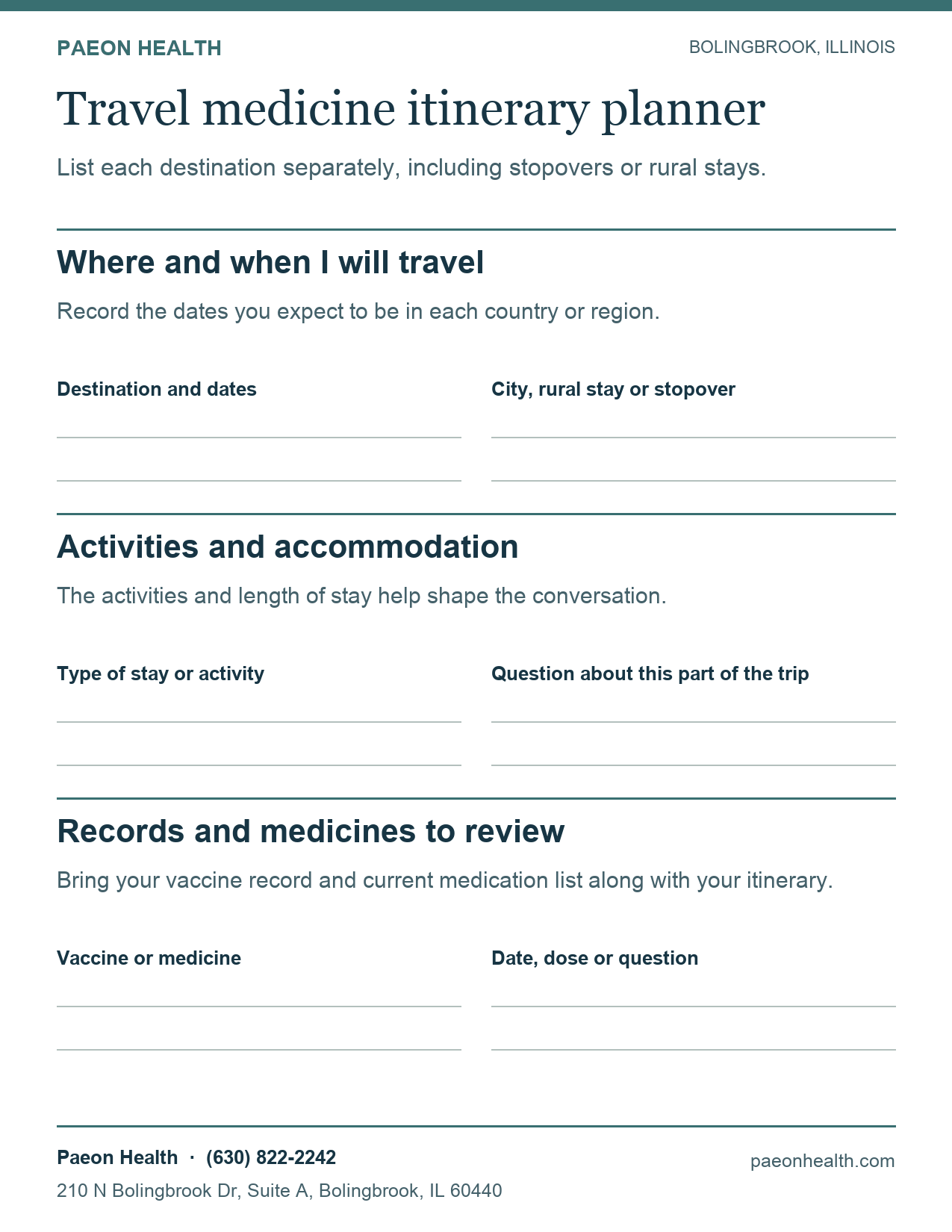
Other records for your travel medicine visit
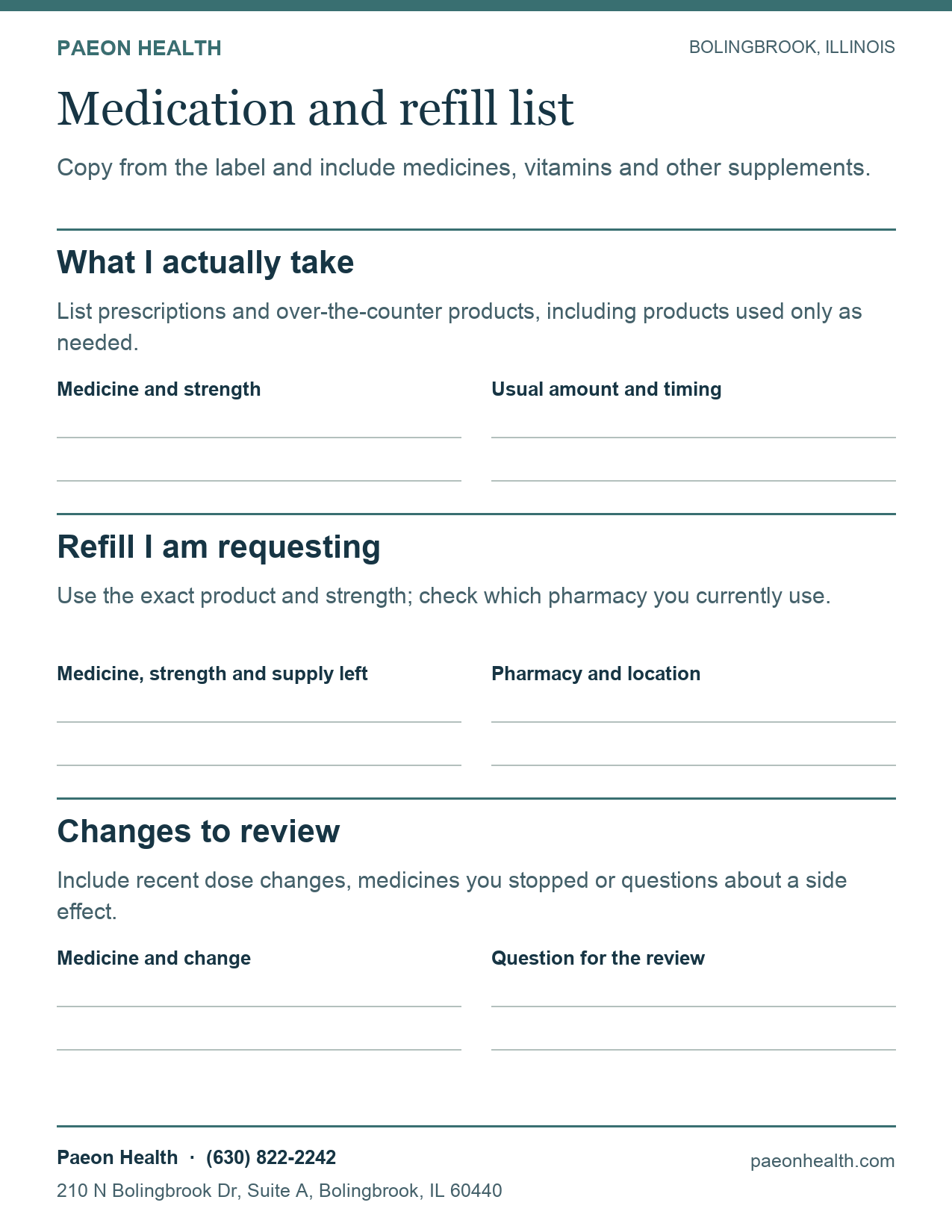
If you travel with prescription medicines
The medication list makes it easier to discuss quantities, pharmacy information and questions about crossing borders with particular products. Destination rules differ, so identify each country you will enter.
Download the medication and refill list (PNG)
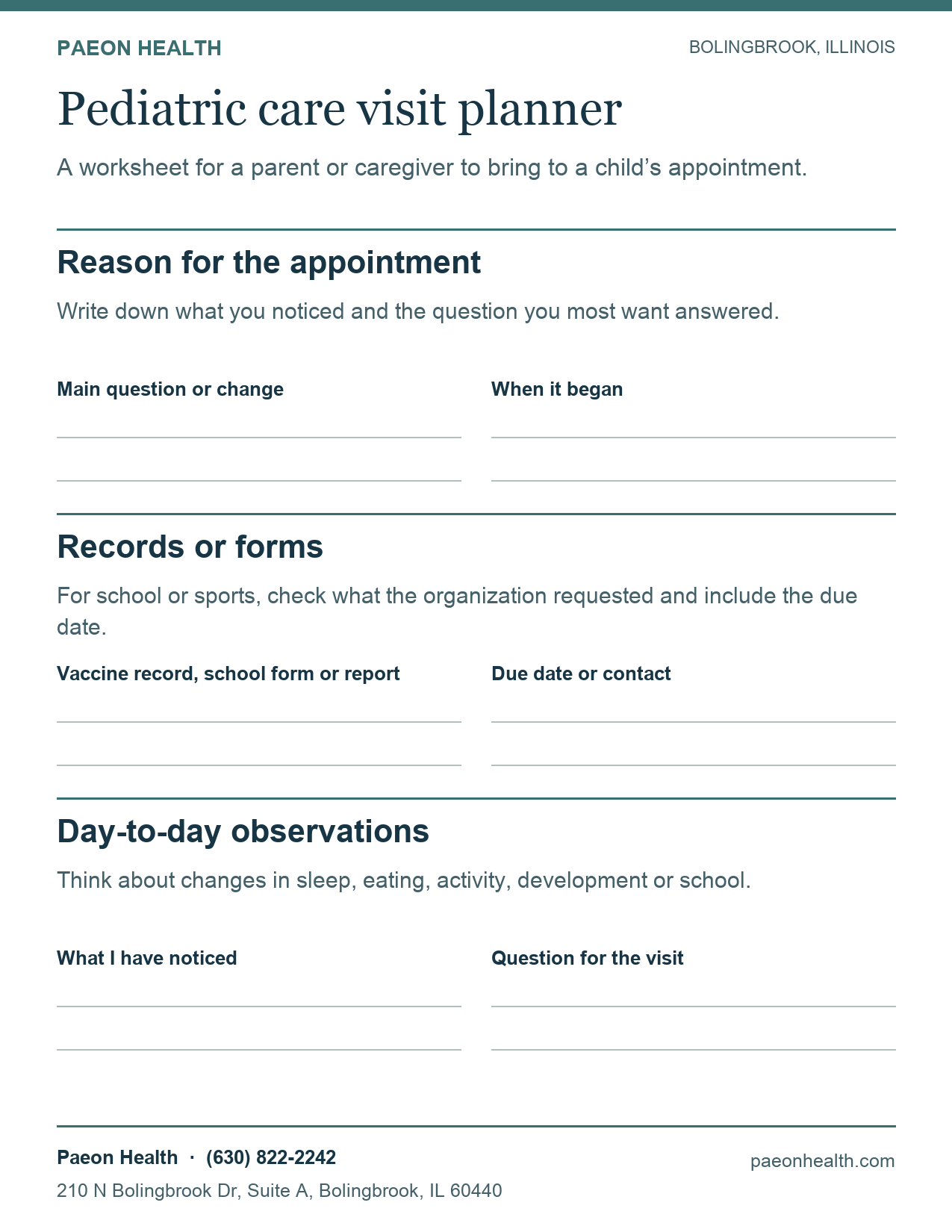
If a child will be traveling
Use the pediatric planner to prepare the child’s own records and questions. Note the child’s age, itinerary and caregiver contact separately from the adults’ visit details.
Download the pediatric care visit planner (PNG)
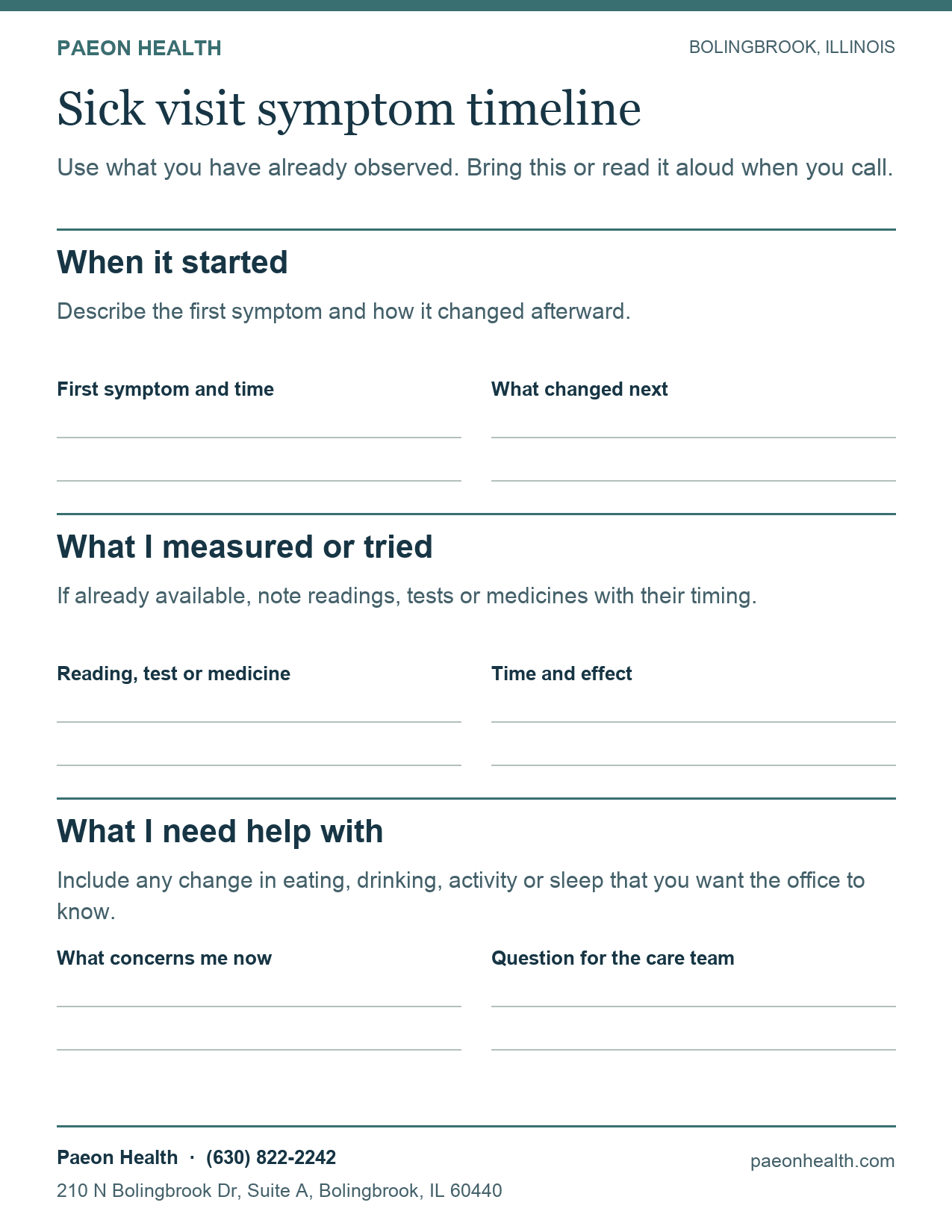
If you become unwell during or after travel
Use the symptom timeline to record when symptoms began in relation to your travel dates. When you contact a clinician, tell them where and when you traveled.
Download the sick visit symptom timeline (PNG)
Insurance & Self-Pay
Network participation depends on your exact plan and where you receive care. Verify your exact plan and network with your insurer. Travel vaccines are often not fully covered by insurance. For self-pay patients, a New Patient Office visit is $225 and an Established Follow-Up is $150. Vaccines and medications are additional costs. A Good Faith Estimate is available.
FAQ
How far in advance should I book? Ideally 4–6 weeks before departure. Some vaccines need multiple doses or take weeks to become effective. Last-minute visits can still provide partial protection and essential advice.
Do I need vaccines for travel to Europe? Routine vaccines should be up to date. Hepatitis A and B may be recommended depending on activities and length of stay. Tick-borne encephalitis vaccine is recommended for some rural European travel in warm months.
Can I get a yellow fever vaccine at Paeon Health? Ask when booking — some special-order vaccines require advance notice. If not available on-site, Dr. Sayyed can refer you to a designated yellow fever center.
What if I’m pregnant or immunocompromised? Some live vaccines are not recommended. Dr. Sayyed will review your situation and recommend safe alternatives and additional precautions.
Do I need malaria pills? It depends on your exact destination (country and region), season, and activities. Malaria risk varies even within a country. Dr. Sayyed will determine the appropriate prophylaxis, if any.
Does Paeon Health offer routine vaccines too? Yes — flu, pneumonia, shingles, tetanus, COVID-19, and other routine vaccines are available.
Ask About a Travel Medicine Visit
Call 630-822-2242 · Explore primary care services
Patient resource: MedlinePlus guide to travelers’ health.
Planning international travel? Book a travel medicine visit with Walid Sayyed, MD, at Paeon Health in Bolingbrook, IL, at least 4–6 weeks before departure. Schedule via the Elation Patient Passport portal, or call 630-822-2242. Mention your destination and travel dates when booking.
This content is for educational purposes only and is not medical advice. For medical emergencies, call 911. To discuss your specific health needs, book an appointment with Walid Sayyed, MD, at Paeon Health or call 630-822-2242.